
Showing posts with label Training. Show all posts
Showing posts with label Training. Show all posts
Monday, May 18, 2015
Thursday, May 14, 2015
The importance of Leash Manners . . .
The same as marijuana is considered a "gateway drug" loose leash can be considered a "gateway behavior".
It is very unusual to see a dog that walks nicely on a leash that has any behavior problems.
If you are struggling with your dog, don't try and train loose leash. Just make it happen. Pulling is forbidden, so don't allow it, ever, past the age of about twelve weeks.
A trainer once said to me "Why would you allow that to happen?" While the comment stung at the time, he could not of been more right. While I did not possess the solution to the problem, I lost all of my presence and belief that I could stop it. My defeat, in turn, made the problem exponentially worse.
Sometimes I need to find my inner little-girl, stomp my feet and say "You will not". As a kid I had much more determination to not allow something I didn't want. Yet as an adult, defeat can sometimes overwhelm us. We all need to find that inner determination, which in turn gives us mental-presence. We need to quit being victims, allowing our dogs to do stuff to us. Rather, we need to be determined leaders, stand tall, and take control of the situation, even when we have no clue how to fix it!
Monique Anstee
Victoria, BC

Thursday, April 16, 2015
Capturing Calmness - "How to train calmness in dogs"
Teaching your Vizsla to be "calm" or settle can seem overwhelming for this busy breed, but it really is necessary. Great instructional video.
Wednesday, April 15, 2015
Dogs are Great People Trainers by The Naughty Dogge
Dogs are Great People Trainers:Dogs are such good teachers, and can train people to do the most bizarre things. And in...
Posted by The Naughty Dogge on Wednesday, 15 April 2015
Saturday, April 4, 2015
We're 7 1/2 weeks old!

The Easy Riders waiting patiently (for about 1/100th of a second) for dinner.
Sunday, March 29, 2015
Go Home Day is not to far away!

I always enjoy putting together my Go Home Bags -- and putting together some fun stuff for the Easy Riders is no different.
Each Moonlight puppy leaves with our "world famous" bag of goodies which includes: a fleece blanket (not shown), toothbrush/toothplaste kit, Kong, plush toy, lots of chewies (bullies, kneecaps, ears, etc), horn, and lots of puppy training/raising/socializing handouts (not shown) and a tote bag. All of this ensures the owners can hit the ground running and get onto socializing and training their new puppy.
Note: Senior Kong because I like the softness of the rubber, it is more durable than the Puppy version and chewier than the Regular version.
Thursday, March 26, 2015
We're learning to love our crate!

All six Easy Riders share a crate while the Kuranda dog bed next to the crate, is empty.
Crate training is the only way to housebreak a puppy and once you establish the crate as their safe haven raising a Vizsla goes much smoother.
Properly Socializing Your Puppy - Whole Dog Journal Article
Young puppies have an important behavioral “sweet spot” between the ages of 8 and 16 weeks. During this critical period, your dog builds her impressions and attitudes about what is normal and acceptable. At this time more than any other, positive experiences with the world around her build a solid foundation for the rest of your dog’s (we hope) long life.
Read the entire article: http://www.whole-dog-journal.com/issues/16_12/features/properly-socializing-your-puppy_20878-1.html
New Owners: Please consider buying a yearly subscription to the Whole Dog Journal.
Thoughts on socializing your puppy --- it is an art not a science . . .
Puppy Raising:
The hardest part of raising a puppy is not to stifle them. Yet we must be there to protect them every step of the way. Finding that balance, between freedom and protection, is a difficult one to find. We want to tend to their every need, and cuddle away every whimper, and when we do, we stunt their emotional growth. We keep the fearful ones fearful, and the bold ones simply find us irritating.
Our puppies must learn to problem solve, and work out their own difficulties. Our job is to find the balance of when to help them, when to give them a kiss and a nurturing shove forward to work it out on their own, to know when to laugh at them for the dumb error that they just committed, when to force them to succeed and then reward them as though it was their own brilliant idea, and when to simply protect them and keep them safe.
When raising a puppy, I use what they offer to build their confidence. My past two weeks have been spent with two wonderful baby boys. Both are needing help dealing with big adult dogs at the park. Both pretend to act over confident and 'cool' when they really would rather climb inside my jacket and be carried! Growing up is scary, and my understanding and help, and hand-holding, has given them the courage to act like stellar lads.
My first little man had a fabulous temperament, and fabulous raising thus far, so he only needed teasing reminders such as "Grab your Ball" when passing a dog. By keeping his mind on the soother in his mouth, his manners were spectacular, and he had the confidence to move on past temptation.
My second little puppy could not have been more different. He had no social skills, and only confidence through his teeth, so pretended he was the biggest and toughest dog in the world. He needed to be carried past dogs and see them from the safety of arms. Then he needed to be on the ground, with hands guiding him, reminding him that is was me and him against the world. Now we are at the stage of going past the dog, and throwing a cookie in the direction that I want him to go (straight past). I am giving him a reason to leave the encounter. I'm not forcing him. It is his choice to leave (so he keeps all his power). I've just presented a darned good reason why he should leave. This little man has given me his heart and soul. He tries hard to please - but he has no idea how to behave. It is my job to show him how. Because of all that he has missed, he is never going to be the role model at the dog park. But he can learn manners, and how to be a well adjusted, confident adult, by being schooled on what is wanted, and by watching my well behaved adult dogs demo for him.
We are repeatedly told that dog training is science. I disagree. I think it is more like art. Each dog is a blank canvas, and it is up to us to create our perfect dog. We are given a topic, and then the creation is left in our own hands.
There certainly is a scientific component to it; If you do this - you will get that. But first you must envision your canvas so that you know what you want to create, and then you use your science to help you get it.
This is the reason that if you present one problem to ten dog-trainers, you will get ten answers. All might be right, but each trainer will create a very different canvas, depending upon what they saw.
Monique Anstee
Victoria, BC
Wednesday, March 25, 2015
The myth of "normal" dogs . . . Future owners - please read this (twice!)
Recently, a colleague and friend posted a picture on FB accompanied by a caption saying something to the effect of "does anyone have 'normal' dogs?" indicating that her dogs had a variety of issues which she was dedicated to working with - separation anxiety, noise sensitivity, fear aggression, etc. "All I ever wanted was a normal dog!"
I hear this a lot in my practice and am forced to ask, "Really? You really think you want a 'normal' dog?!"
What exactly is a 'normal' dog?
Here are some characteristics of normal dogs:
- normal dogs bite
- normal dogs have no standards as to appropriate elimination sites with the exception of "where I sleep is out of bounds"
- normal dogs do not come when called if something more interesting is going on
- normal dogs default to responding to new stimuli in their environment fearfully. Fear is a survival adaptation and keeps a dog safe.
- normal dogs chew, dissect, and destroy things
- normal dogs resource guard
- normal dogs bark and growl
- normal dogs dig holes
- normal dogs hump legs
- normal dogs vocalize when left alone
- normal dogs chase squirrels, deer, and cats
- normal dogs kill small animals
- normal dogs pull on the leash
- normal dogs often like to run around as fast as they can, even if they knock over small children or grandma in the process
- normal dogs lift their legs and pee on trees, even when we bring those trees into our houses and put lights and ornaments all over them
- normal dogs like to sniff EVERYTHING - crotches (human and canine), fire hydrants, trees, bushes, gopher holes
- normal dogs eat poop
- normal dogs tear up the garbage, counter surf, and eat expensive panties or heels
- normal dogs roll in poop and dead things
- normal dogs do not like every dog they meet
- normal dogs do not want to be hugged, kissed, touched, or stared at by every person they meet in every situation
- normal dogs don't like having their nails trimmed, mats removed from their coat, or grooming
- normal dogs don't naturally love being crated
- normal dogs don't naturally love wearing sweaters, being carried in purses or strollers, or wearing booties
Looking at all these things that normal dogs do, how many of you want one? All of these things are NORMAL DOG BEHAVIORS. If humans did not intervene, these are the things that dogs would do naturally. I'd argue that very, very few humans would even know what to do with a truly "normal" dog if they came across one. Normal dogs do not make good pets.
What we want in a pet dog is abnormal behavior. We want a creature which has evolved for millennia as a hunter to act like prey doesn't matter. We want dogs to learn to go potty outside the house, even when we bring doggy bathrooms (trees) into our homes as holiday decorations. We want dogs to like every dog and person they meet. We want dogs to be silent animals. We want dogs to walk politely on a loose leash, even though our walking pace is comparatively very slow. (Have you ever been caught behind someone who moves slowly when you're in a hurry, either walking or driving? Frustrating!) We want dogs to never bite, no matter what, even when they are harassed, abused, and neglected.
What we want from dogs are behaviors which are ethologically incompatible with their evolution as a species. We like dogs, but not their "dogginess." Normal dogs end up in shelters for just this reason. Abnormal dogs get to stay in their homes.
Part of the problem is also in what is defined as "normal dog owner" behavior. "Normal" dog owners:
- don't take their dog to class
- don't go out of their way to socialize the dog extensively and appropriately during puppyhood
- place their dog's physical and mental stimulation needs somewhere around #894 on their list of priorities
- don't manage their dogs to prevent rehearsal of bad behavior
- focus on what their dog is doing "wrong" and ignoring the dog when he does the "right" things
- don't train their dogs and then blame the dog for misbehaving
- expect dogs know the difference between "right" and "wrong" naturally
- look for a quick fix to behavior problems
- choose to confine the dog to the back yard, turn him into a shelter, or have him euthanized before consulting with a behavior professional to address the problem
Normal dog owners get normal dog behaviors. Abnormal dog owners are proactive about preventing behavior problems and address any new problems as soon as they are noticed. If they don't know what to do about a problem, they research to find a good trainer who uses dog-friendly training methods. They exercise and train their dogs, even if they are busy. They make spending time with the dog and helping him thrive a priority.
While no dog is perfect, realizing that virtually everything we expect of dogs is unnatural for them highlights the need for training. Part of what makes dogs so wonderful is the fact that they are generally more than happy to exchange behaviors which are rooted in hundreds of thousands of years of instinct for an owner that will spend a few minutes a day training them to offer alternative, incompatible, and socially desirable behaviors.
Dogs don't come "perfect," whether they are brought into the home as puppies or as adult dogs they need training. Well-behaved dogs rarely happen by chance, they are usually well-trained dogs. "Bad" behavior in dogs is not bad behavior to dogs, it is simply normal behavior. I think that society does dogs a disservice with the assumption that "good behaviors" are the norm and "bad behaviors" are aberrant. It is the dogs that pay for this misunderstanding, often with their lives. It's like something out of the Twilight Zone.
Carefully review the list of normal dog behaviors above. If these are not the behaviors you want, you need to train your dog to offer abnormal behaviors. In doing so, you will leave the ranks of "normal dog owners" and join us crazy folks in the "abnormal dog owner" realm.
It's not so bad - we have lots of treats, toys, and fun here with our "abnormal dogs!"
---
Published 2010 - http://www.dogster.com/lifestyle/the-myth-of-normal-dogs
Sunday, March 22, 2015
ATTN: Future Puppy Owners! ;)

Please read the entire website -- get ready it's your TWO WEEK COUNTDOWN!
The Ultimate Puppy - http://www.ultimatepuppy.com
Monday, March 16, 2015
The Puppy Playpen and Potty Box

Bed and toys one end and potty box in the other end.

The Easy Riders hanging on the bed next to the Puppy Plaything -- which is a PVC puppy mobile of sorts. The puppies are socialized to items of different sizes and shapes and they can bump into the items getting used to things touching their head/bodies.

Another view.

The flooring is vinyl which is mopped, bleached and cleaned 3x's a day. This ensures the puppies utilize the puppy pellet box which keeps them clean and aids with housebreaking.
Most days as their breeder, I feel like Cinderella with a mo and rubber gloves -- but I know it's easier than the alternative (wet/messy/poop smeared newspaper or potty pads). AND -- the owners will thank me later when the puppy has a great start on their housebreaking.
Tuesday, March 10, 2015
How to handle Puppy Nipping . . .

What "not" to do follows the old school way of interacting with dogs and as noted, leads to problems (most seriously, fear-agression). Remember puppies explore with their mouths so biting and nipping is NORMAL behavior.
Monday, March 9, 2015
Puppy Housetraining -- the biggest challenge, or is it?
Puppy Housetraining -- the biggest challenge, or is it?
Successful house-training is one of the first things parents of a new puppy need to accomplish, and even though the process can be time-consuming, it does not have to be daunting. With a combination of consistency, common sense, and positive reinforcement protocols, you can quickly train any puppy to toilet appropriately.
Crate Training
Crate training is the ONLY way of encouraging puppies to hold themselves for longer periods of time and keeps puppies safe when unsupervised. If you use the crate correctly, it will become a safe space for your puppy as well as a highly effective toilet training tool.
Stay Alert!
Regardless of which method you use to housetrain your puppy, remain especially vigilant and prepared for a pup to eliminate at the following times:
- Immediately after meals or water
- After training sessions
- Immediately after waking up
- After vigorous play
- When overly excited
- You must have TWO EYES on the puppy AT ALL TIMES -- or they need to be in their crate, behind a gate, etc.
What Not to Do:
- Never scold a pup or adult dog for toileting inappropriately and never rub his nose in or near his mess. Dogs do NOT toilet inappropriately out of spite. You will only cause your dog to fear you and toilet in secret or when you are out of sight.
- Leaving poorly house-trained puppies or dogs in the home unsupervised sets them up to fail unless they are in a safe area.
Teach a "Go Potty" Command
- You should be taking your puppy outside to eliminate so that you can offer appropriate praise. Incorporate at "Go Potty" command so the puppy quickly learns to do their business. I find this command invaluable for travel when a quick pit stop is needed.
Puppy Development - Week 3 to 4
Puppy Development - Week 3 to 4
The Easy Riders are now 4 Weeks Old!
The Easy Riders are now 4 Weeks Old!
At this stage "fear" has not yet developed and this is the age where the puppies need to be exposed to sudden noises like turning on the vacuum, radio, TV, hair dryer etc. The puppies are now listening to Sound Socialization CD's (you can see examples on the Clean Run website) which have gunshots, sirens, babies crying and the like.
The startle response needs to be experienced and the puppy allowed to return to normal quickly before the fear stage begins. This needs to happen so the puppy knows that when startled throughout the rest of his life, he can return to normal and everything will be ok. A puppy that has not had these experiences during this stage of development will more than likely be a "fearful" dog as a adult (just another reason you want to adopt from a reputable breeder who socializes their litters).
The puppies will begin a loose pecking order at this stage and start "play fighting" with each other. I have already introduced them to pee pads, and pellets (the beginning of their house training). During Weeks 3-4 they will also begin to eat food, but still be nursing their mom as well. This past weekend they will be started on "gruel" which is ground up/wet kibble/dehydrated raw food.
As the week goes by Lyra will begin to teach them to nurse more gently and when to quit as their teeth have already started to appear (by 3 1/2 weeks). This is one of the first lessons in discipline.
Over the next few days the puppies will be moving out of the whelping box to the PUPPY PARTY PALACE and be exposed to the PUPPY PLAYTHING and teeter totters, boxes, toys and various objects . . . STAY TUNED!
Friday, February 27, 2015
10 Reasons Not to Use a Retractable Leash

10 Reasons Not to Use a Retractable Leash
- The length of retractable leashes, some of which can extend up to 26 feet, allows dogs to get far enough away from their humans that a situation can quickly turn dangerous. A dog on a retractable leash is often able to run into the middle of the street, for example, or make uninvited contact with other dogs or people.
- In the above scenario, or one in which your pet is being approached by an aggressive dog, it is nearly impossible to get control of the situation if the need arises. It's much easier to regain control of – or protect -- a dog at the end of a six-foot standard flat leash than it is if he's 20 or so feet away at the end of what amounts to a thin string.
- The thin cord of a retractable leash can break – especially when a powerful dog is on the other end of it. If a strong, good-sized dog takes off at full speed, the cord can snap. Not only can that put the dog and whatever he may be chasing in danger, but also the cord can snap back and injure the human at the other end.
- If a dog walker gets tangled up in the cord of a retractable leash, or grabs it in an attempt to reel in their dog, it can result in burns, cuts, and even amputation. In addition, many people have been pulled right off their feet by a dog that reaches the end of the leash and keeps going. This can result in bruises, "road rash," broken bones, and worse.
- Dogs have also received terrible injuries as a result of the sudden jerk on their neck that occurs when they run out the leash, including neck wounds, lacerated tracheas, and injuries to the spine.
- Retractable leashes allow dogs more freedom to pull at the end of them, which can look like aggression to another dog who may decide to "fight back."
- The handles of retractable leashes are bulky and can be easily pulled out of human hands, resulting in a runaway dog.
- Along those same lines, many dogs – especially fearful ones – are terrorized by the sound of a dropped retractable leash handle and may take off running, which is dangerous enough. To make matters worse, the object of the poor dog's fear is then "chasing" her, and if the leash is retracting as she runs, the handle is gaining ground on her – she can't escape it. Even if this scenario ultimately ends without physical harm to the dog (or anyone else), it can create lingering fear in the dog not only of leashes, but also of being walked.
- Retractable leashes, like most retractable devices, have a tendency to malfunction over time, either refusing to extend, refusing to retract, or unspooling at will.
- Retractable leashes are an especially bad idea for dogs that haven't been trained to walk politely on a regular leash. By their very nature, retractables train dogs to pull while on leash, because they learn that pulling extends the lead.
Monday, February 23, 2015
Things Vizsla Owners Wish They Had Known Before Getting Their First Vizsla

At home with Zene, Csilla, Cordie and Lyra
About Vizsla ownership, you might have heard, "You will never go to the bathroom alone again".
Well, its true!
Check out the entire article "Things Vizsla Owners Most Wish They Had Known in Advance of Getting Their First Vizsla" (from a poll of VizslaTalk list members). Link:
Sunday, February 22, 2015
Which Types of Collars and Harnesses are Safe for Your Dog?
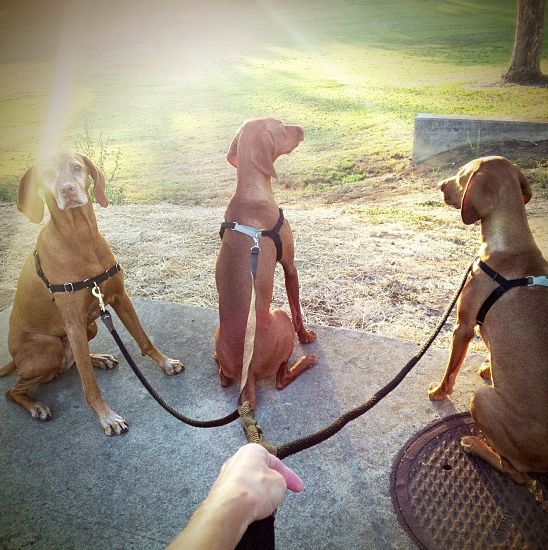
3 Vizslas/one walk using no-pull harnesses (L to R: Csilla, Lyra and Zene)
Which Types of Collars and Harnesses are Safe for Your Dog? by Dr. Sophia Yin
Dr. Yin shares an excellent overview of a variety of common collars and harnesses. None is perfect. They are all just tools. But some are more likely to cause problems in your pet or may just provide a less than ideal match for your needs. In case you're wondering which I prefer—ideally my dogs can walk on leash with the flat collar that they wear regularly. But for those dogs that tend to pull (or when I walk multiple V's) I recommend a front-attaching harness or a head collar of some sort.
Read the entire article: http://drsophiayin.com/blog/entry/which-types-of-collars-and-harnesses-are-safe-for-your-dog
*** Please no choke chains or prong collars on a Vizsla.
Sunday, February 15, 2015
Our First Mani/Pedi

Top paw has been clipped.
Vizslas are a relatively easy (wash and wear) breed, and the only regular grooming needed is nails and teeth. NAILS SHOULD BE DONE WEEKLY.
Toenails are first trimmed at 3-4 days old (with regular nail clippers) and every 3 days thereafter. You would not believe how long the nails get and if left untrimmed they can scratch one another in the eye or tear up mom's nipples and teats.
Ariel (above) was a willing participant after eating and getting ready for another nap. You can also see the dissolvable surgical glue on her removed dew claw, not to worry.
At 2 weeks old the puppies are started on the dremel (on low speed). It is so much faster and easier than clipping! I use a cordless version for pups and adults, $40 +/- on amazon.com, link to buy:
Pups will be acclimated to the dremel by the time they go home and the owner is required on puppy "Go Home Day" to demonstrate their ability to trim the nails (and bring their dremel!). This is a weekly requirement for each Moonlight Vizsla Puppy owner.
If you can hear your dog's nails on the floor, they are already too long!


Photo from one of my puppy owners when the pup was about 6 months old.
---
Helpful diagram showing nail care in the young/adult dog.
Subscribe to:
Posts (Atom)